Following the Water
How can water-based artistic methods help us sense, question and live with the convergence of ecological, technological and social systems?
Portfolio Submission for for FAE Fellowship
*** Please ensure volume is on when watching videos, the last video is 6 minutes long summarising 5 of the below projects
1. Syzygy of the Tides: Sleeping with the Tides
Role: Artist, researcher
What: A work-in-progress from S+T+ARTS Aqua Motion: for seven days and nights I lived alone inside Viana do Castelo’s historic tidal mill, working and sleeping in sync with the tides. Weather data, GPS walks, field recordings and plotted live readings became ways to understand water as labour, energy, isolation, infrastructure and community.
This took place in the final week of May 2026, so this video is a first draft of an artist essay.
Relevance to FAE:
This project is directly relevant to the FAE Fellowship because it shows my commitment to embodied R&D: entering a complex system through water, sleep, data, sound and infrastructure in order to understand convergence from within.
Above: Sleeping with the Tides, documentation from an embodied research carried out within my S+T+ARTS AQUA MOTION Residency
Above: video summarising Projects 2 - 6, please watch with volume on
2. 372.5~ River Thames 2025, Space House X Earth Day
Role: Artist, designer, producer
What: A kinetic sculpture installed on the 15th floor of London’s iconic Space House ahead of Earth Day 2025, 372.5~ River Thames visualises real-time tidal data from the Thames through a delicately engineered system of pulleys and counterweights. Inspired by the historic Doodson Légé machine (originally built in 1948), which automated tidal predictions, this piece reimagines a legacy of mechanical intelligence in dialogue with contemporary digital methods by visualing data obtained from an API Key.
Relevance to FAE: The work raises questions about how we measure, mechanise, and emotionally respond to natural systems—a core interest of my practice. Alongside the kinetic sculpture, I also plot tidal data as physical visualisations using a drawing machine—materialising wave behaviour as ink on paper and continuing a tactile, embodied engagement with data.

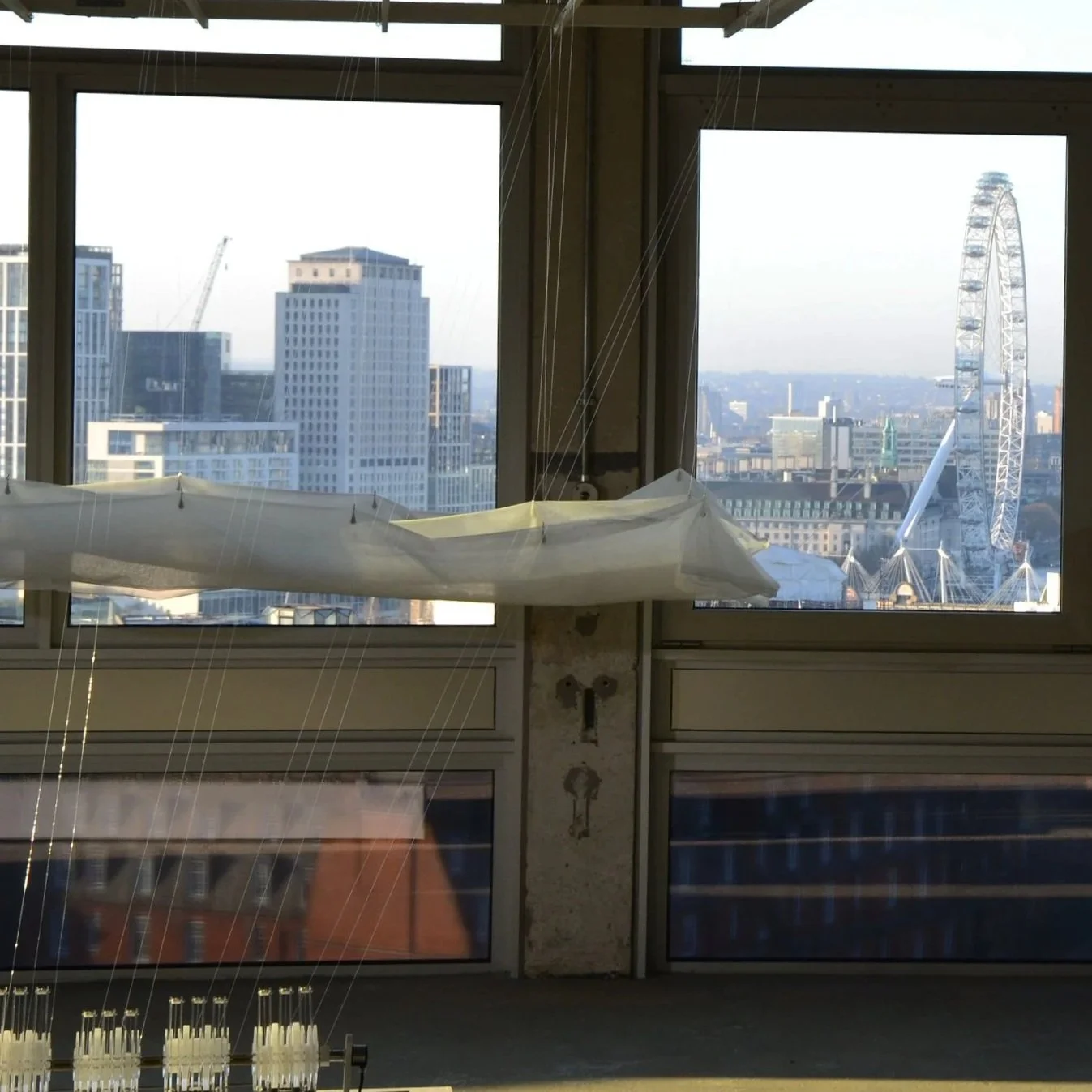


Detailed images of the sinusoidal cam-shaft machine I designed and built using a motor and adapted with 3D printing technology. Inspired by the Doodson Légé device
3. The Lowly Barnacle, 2023, Research Project
Role: Artist, Researcher
What: A research project funded by Arts Council England (DYCP), this work-in-progress kinetic sculpture explores barnacle behaviour as a model for understanding artificial intelligence. Drawing on Darwin’s evolutionary theory and Alan Turing’s fascination with crustaceans, The Lowly Barnacle uses a trained machine learning model to trigger responsive movement in 3D-printed barnacle forms. Above-water sounds prompt stillness; underwater acoustics trigger opening and animation, mirroring real barnacle mating and feeding strategies.
Relevance to FAE: By positioning marine adaptation as a metaphor for continuous learning, the piece reframes AI through a hydrofeminist lens—emphasising care, responsiveness, and interconnection. It invites audiences to consider both ethical and ecological implications of intelligent systems.


4. Tides Institute & Museum of Art, 2023, Residency
Role: Artist in Residence
What: During a one-month residency in Eastport, Maine—a site known for having the world’s highest tides—I developed community-focused workshops in creative technology. Working with local high school students, I introduced principles of physical computing and environmental sensing. Using Arduino boards and tide data from NOAA and our own field collection, students created mechanical tide visualisations and trained a basic model to predict future water levels.
Relevance to FAE: This project reflects my ethos of making data experiential and accessible, and my belief in long-term pedagogical impact. It also underscores how art and AI can build resilience and curiosity within economically challenged coastal communities.
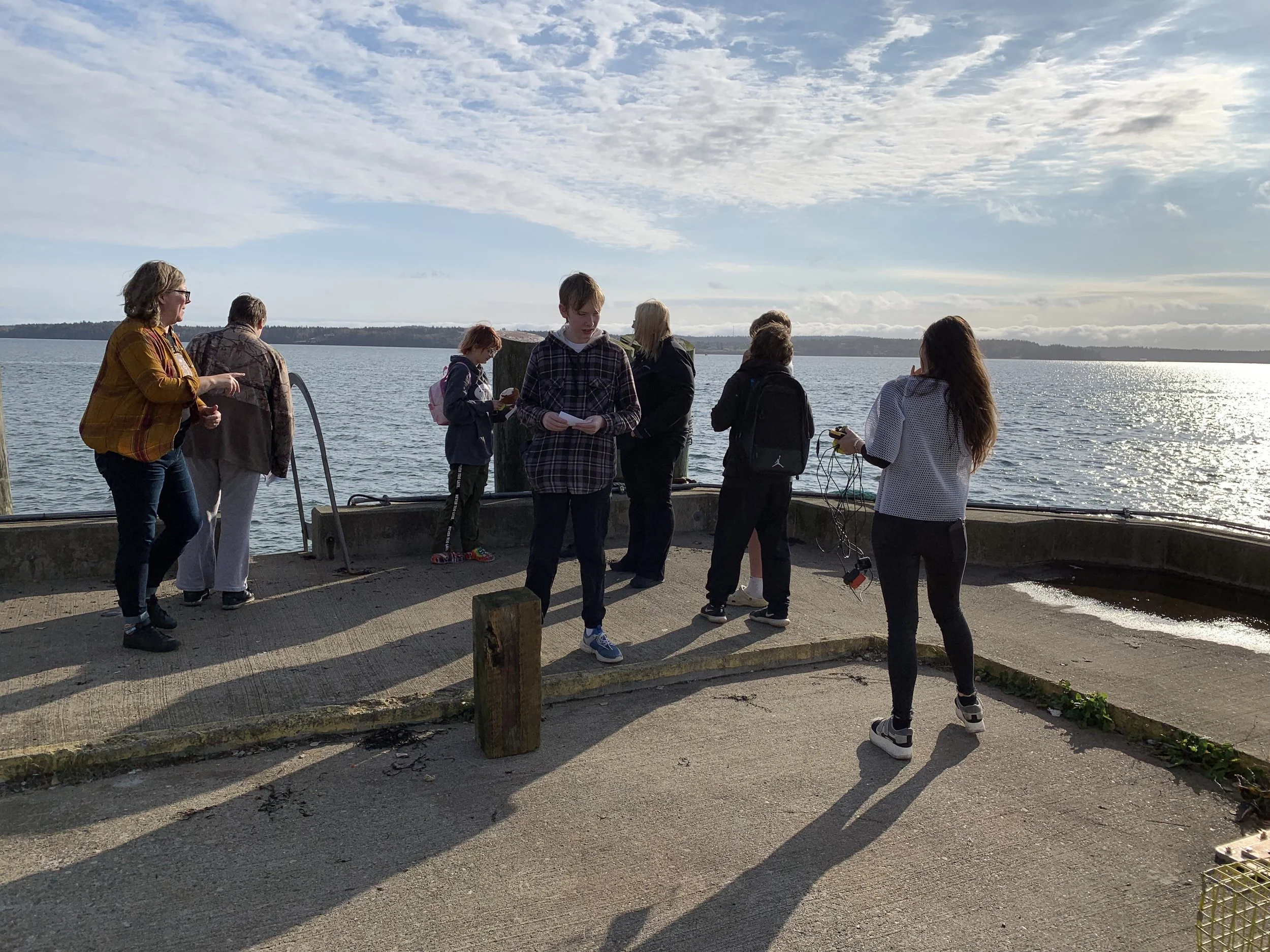
Above: image of me hosting a workshop in Eastport, where we went out and measured water levels with a depth transducer to compile our own dataset
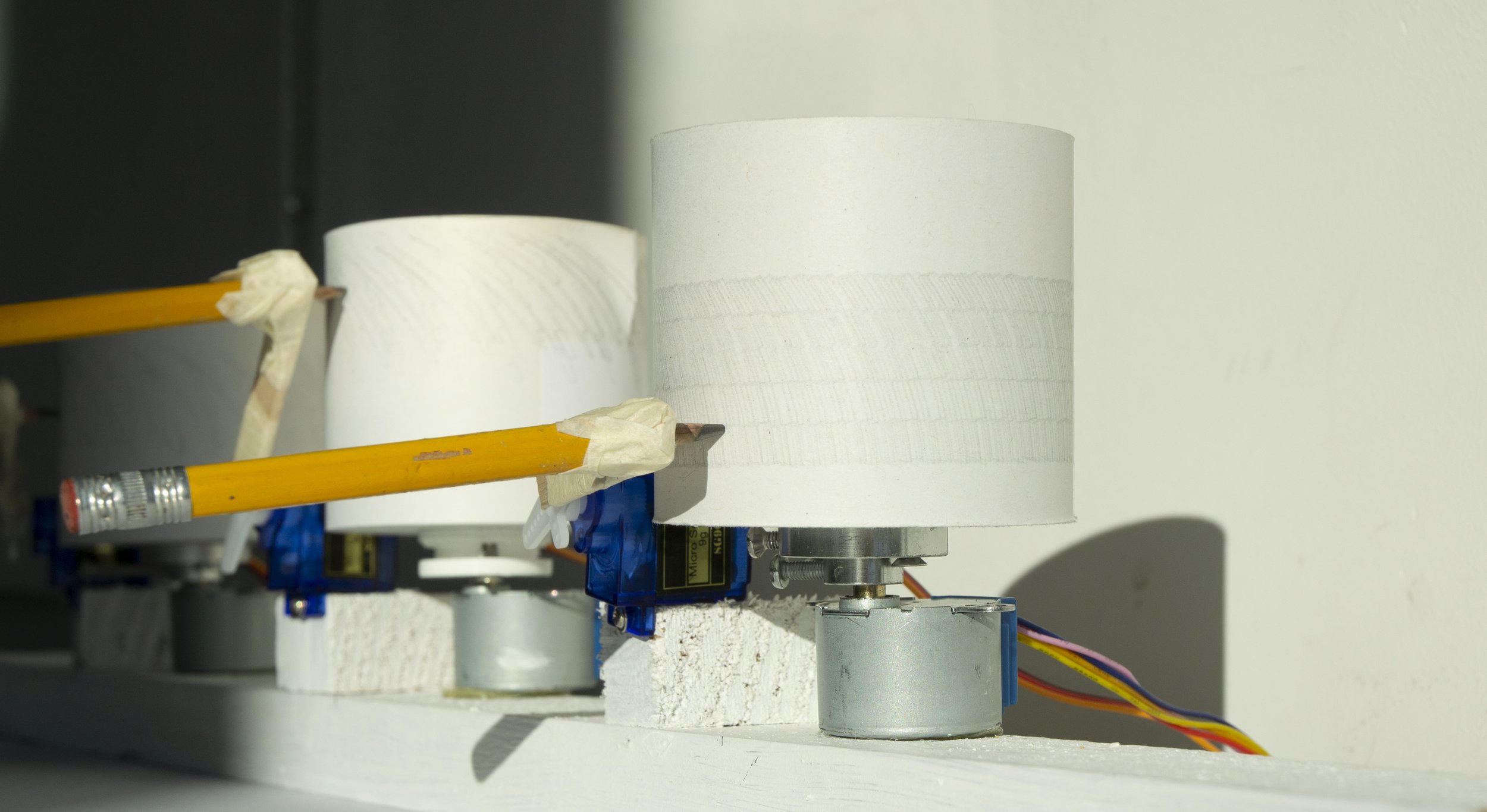
Image of artefact developed with students from Eastport High School that visualises the water level datasets we collected as a group
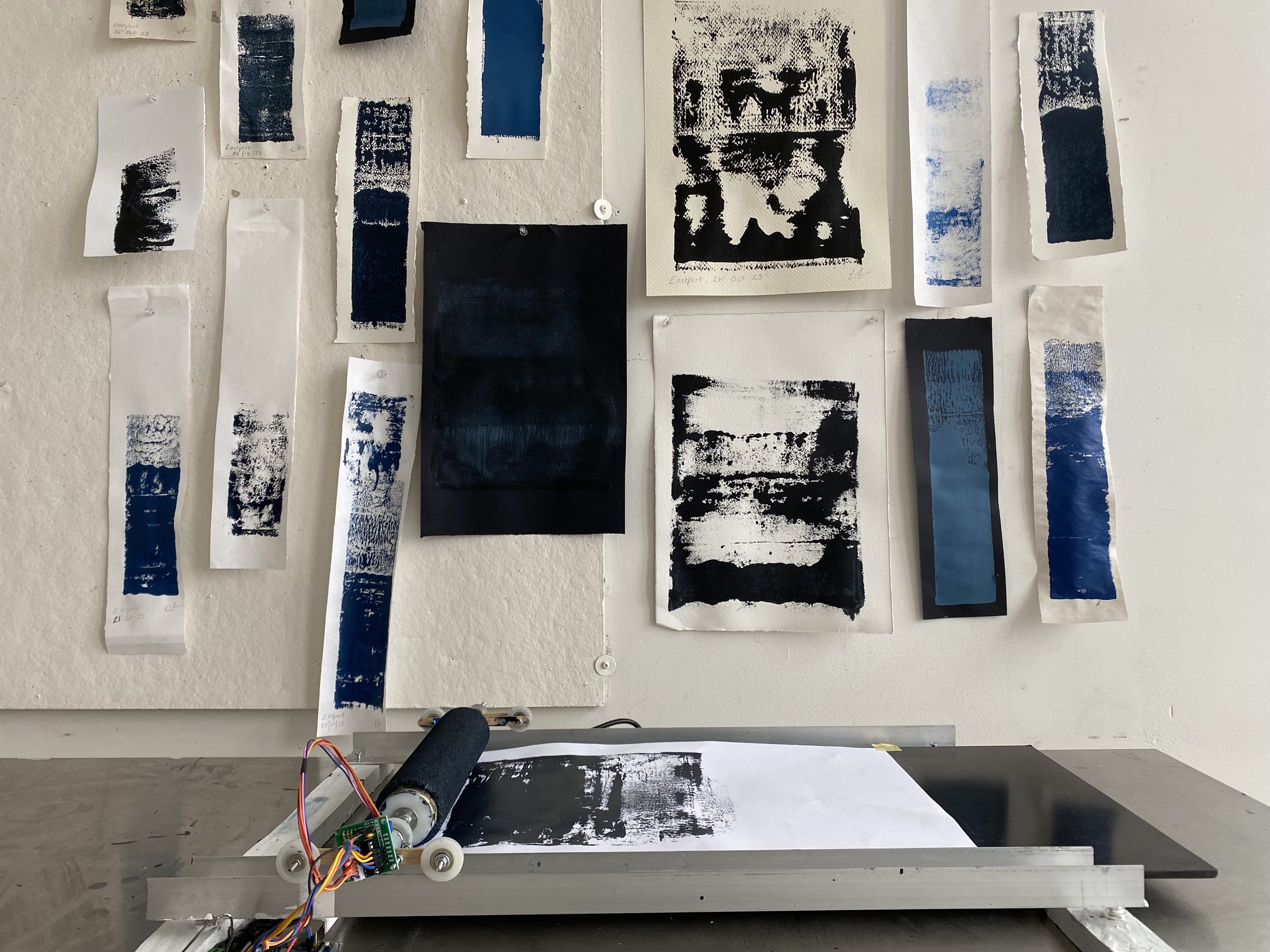
Above: Using a micro computer and a paint roller, I built a device that painted the tidal level data that was being read live from outside my studio in Eastport.
5. SEE~TURTLES
Role: Artist, developer, producer
What: An immersive, sensory installation addressing plastic pollution and marine perception. Through motion tracking, recycled materials, and computer vision, the work simulates the disorienting experience turtles face when mistaking plastic for prey. Viewers activate kinetic jellyfish and generative spirals through their movements, visualising the blurred boundaries between waste and sustenance. The piece uses responsive technologies and poetic coding to challenge anthropocentric perspectives and bring viewers closer to oceanic consciousness.
Relevance to FAE: SEE~TURTLES embodies my commitment to embedding care ethics and environmental storytelling within interactive design.

Above: installation shot, plastic bag suspended from a micro motor and projections
6. Sounds of the Sea, 2023
Role: Artist, devleoper, producer
What: This moving image piece combines gestural choreography, sound synthesis, and computer vision to explore watery entanglements through hydrofeminist philosophy. A double exposure of the artist’s hands and the sea is mediated by an AI system: as the hands move, they trigger modulations in white and pink noise, creating a sonic landscape that mimics tidal rhythms. This work treats AI not as an instrument of control but as a collaborator in listening and feeling.
Relevance to FAE: Sounds of the Sea invites the viewer into a space of slowness, reflection, and ambiguity, offering a counterpoint to the extractive tendencies often associated with digital technologies.


Above: stills / screenshots of the software program I developed to create Sounds of the Sea, with MaxMSP and computer vision
7. Hydro- Quantum , 2024
***minutes 2-3 are most relevant to this application, no need to watch it all!
Role: Artist in Residence, collaborator, video produced by Petja Ivanova
What: Developed during a micro residency with Studio Quantum with Petja Ivanova, this video essay uses water to think through quantum coherence, memory and ecological relation. Emerging from shared research and dialogue, it connects environmental systems with quantum imaginaries, asking how water might help us understand complexity beyond linear or extractive technological narratives.
Relevance to FAE: